Supported identifiers
You do not have to convert your files before uploading them. PaintOmics reads the first column of each data file as a feature name and looks that string up in the identifier tables it installed for your organism, then translates it into whatever identifier each pathway database is keyed on. This page says which strings it can recognise, how the translation works, and what to do when a file maps badly.
Two things are true of everything below, and it is worth reading them first.
- Support varies by organism, and by server. The identifier types an organism accepts are whatever its installer actually built, and the pathway databases it can be analysed against are whatever that server installed for it. Nothing here is universal.
- The mapping summary in Step 2 is the only authority for your own file. It reports, per omic and per database, how many of your features resolved. If this page and that card disagree about your organism, the card is right.
How a name becomes an identifier
Every gene-based omic goes through the same three steps when you press Run PaintOmics.
- Your string is looked up exactly as you typed it. The lookup does not filter on identifier type, so an Ensembl gene id, a UniProt accession and a gene symbol all go through the same query — and a column that mixes them works.
- The identifiers that name the same gene are collected, and among them PaintOmics takes the one the selected database is keyed on. That target is different for each database, and for KEGG it is different for each organism.
- If that fails, one further hop is tried, and only through gene-level identifiers: NCBI Gene ID, Ensembl gene id and KEGG gene id. Transcript and protein identifiers are deliberately excluded from this hop, because a shared peptide can join two paralogues — PaintOmics will not map your gene onto a family member to gain a match.
The gene-side match is literal
It is an exact, case-sensitive string comparison, and nothing is stripped.
A versioned Ensembl id (ENSMUSG00000102693.2) is a different string from
ENSMUSG00000102693 and matches nothing. If nothing at all maps,
PaintOmics says so and, when it recognises version suffixes in your
unmatched identifiers, tells you to strip them and run again. Metabolite
names are the exception: they are matched case-insensitively (see
Metabolites and other compound-based omics).
What each database is keyed on
| Database | Your features are translated into | Where it is offered |
|---|---|---|
| KEGG | The NCBI Gene ID for ten organisms; KEGG's own gene id for all the rest | Every organism, always — the KEGG checkbox is ticked and disabled, and the server adds KEGG to every job whatever you submitted |
| Reactome | Reactome's own gene identifier, which is an upper-cased gene symbol | 15 of the 23 organisms configured in this release, where the server installed Reactome data for them |
| MapMan | The MapMan gene identifier its bin mapping uses | Arabidopsis, tomato, potato and rice |
| OmniPath | A UniProt accession | Human, mouse and rat only — the OmniPath web service serves no other organism |
The organisms whose KEGG data is keyed on the NCBI Gene ID are human,
mouse, rat, cow, pig, dog, chicken, chimpanzee, green anole and Xenopus
tropicalis. Every other organism — including zebrafish, fruit fly, worm, both
yeasts, Plasmodium, Dictyostelium and all the plants — is keyed on
KEGG's own gene id, which spells a gene differently in each organism
(Dmel_CG3068 for fly, CELE_C17G1.7 for worm, Os01g0147900 for rice under
the RAP-DB code). You never have to type these yourself; they are the target
of the translation, not an input requirement.
An organism that has no identifier configuration at all is offered KEGG and nothing else, even if pathways from another database are sitting in its database — a source whose identifiers cannot be mapped would contribute pathways that stay permanently empty, so it is not offered.
Which databases you actually see
Step 1 asks the server which databases are installed for the organism you picked, ticks those, and disables the rest with a not installed tag. The answer is computed per organism from two facts: that database's pathways are loaded for that organism, and that organism has an identifier mapping for it. Changing the organism re-ticks and re-labels the row.
If that request fails, Step 1 offers every database and prints a note under the checkbox group saying so. A row where all four boxes are tickable is a degraded state, not a server that has everything.
What you can upload
The identifier types an organism accepts are decided by its build script. Each build step registers its own identifier types, and a step whose download was missing is skipped with a warning — the organism installs anyway, without those types.
| Build step | Identifier types it installs |
|---|---|
| KEGG mapping | UniProt accession, NCBI Gene ID, KEGG gene id, KEGG gene symbol and its synonyms |
| Ensembl | Ensembl gene, transcript and protein ids, and NCBI Gene ID |
| RefSeq accessions | RefSeq RNA and protein accessions, curated and predicted |
| RefSeq gene symbols | Gene symbols and their synonyms |
| UniProt | UniProt accession and UniProt identifier |
| MapMan | MapMan gene identifier |
| Reactome | Reactome gene identifier |
Most installed organisms run only the KEGG mapping step. The source tree carries a bespoke build script for 24 organisms; every other organism is built by the default script, which runs the KEGG mapping and nothing else. Those organisms accept UniProt accessions, NCBI Gene IDs, KEGG gene ids and KEGG gene symbols with their synonyms — and nothing else. On the public server at paintomics.uv.es, which listed 133 organisms on 21 August 2026, that is about 110 of the list.
Organisms with an identifier configuration
These 23 organisms have an entry in the shipped identifier configuration. That entry is what names the target identifier for each database, so it is also what decides which databases the organism can be offered at all: an organism absent from it is offered KEGG and nothing else, and resolves through KEGG gene ids and KEGG gene symbols. Twenty-two of the 23 also have a build script of their own; the last column is what that script asks for, not a guarantee that every table came out populated — see the caveat under the table.
| Organism | Code | Databases it can offer | Build steps its install runs |
|---|---|---|---|
| Anolis carolinensis (green anole) | acs | KEGG | Ensembl, RefSeq accessions, RefSeq symbols, UniProt |
| Arabidopsis thaliana | ath | KEGG, MapMan | Ensembl, RefSeq accessions, RefSeq symbols, UniProt, KEGG mapping, MapMan |
| Bos taurus (cow) | bta | KEGG, Reactome | Ensembl, RefSeq accessions, RefSeq symbols |
| Caenorhabditis elegans | cel | KEGG, Reactome | Ensembl, RefSeq accessions, RefSeq symbols, UniProt, KEGG mapping |
| Canis lupus familiaris (dog) | cfa | KEGG, Reactome | Ensembl, RefSeq accessions |
| Danio rerio (zebrafish) | dre | KEGG, Reactome | Ensembl, RefSeq accessions, RefSeq symbols, UniProt, KEGG mapping — its Ensembl and RefSeq steps produced nothing, see below |
| Dictyostelium discoideum | ddi | KEGG, Reactome | UniProt, KEGG mapping |
| Drosophila melanogaster (fruit fly) | dme | KEGG, Reactome | Ensembl, RefSeq accessions, RefSeq symbols, UniProt, KEGG mapping |
| Gallus gallus (chicken) | gga | KEGG, Reactome | Ensembl, RefSeq accessions, RefSeq symbols, UniProt |
| Homo sapiens (human) | hsa | KEGG, Reactome, OmniPath | Ensembl, RefSeq accessions, RefSeq symbols, UniProt |
| Mus musculus (house mouse) | mmu | KEGG, Reactome, OmniPath | Ensembl, RefSeq accessions, RefSeq symbols, UniProt |
| Oryza sativa japonica (rice) | osa | KEGG, MapMan | KEGG mapping, MapMan |
| Oryza sativa japonica, RAP-DB identifiers | dosa | KEGG | Ensembl, KEGG mapping — its Ensembl tables were registered and never filled, see below |
| Pan troglodytes (chimpanzee) | ptr | KEGG | Ensembl, RefSeq accessions, RefSeq symbols |
| Plasmodium falciparum 3D7 | pfa | KEGG, Reactome | RefSeq accessions, RefSeq symbols, KEGG mapping |
| Rattus norvegicus (rat) | rno | KEGG, Reactome, OmniPath | Ensembl, RefSeq accessions, RefSeq symbols, UniProt |
| Saccharomyces cerevisiae (budding yeast) | sce | KEGG, Reactome | Ensembl, RefSeq accessions, RefSeq symbols, UniProt, KEGG mapping |
| Schizosaccharomyces pombe (fission yeast) | spo | KEGG, Reactome | UniProt, KEGG mapping |
| Solanum lycopersicum (tomato) | sly | KEGG, MapMan | Ensembl, KEGG mapping, MapMan |
| Solanum tuberosum (potato) | sot | KEGG, MapMan | KEGG mapping, MapMan |
| Sus scrofa (pig) | ssc | KEGG, Reactome | Ensembl, RefSeq accessions, RefSeq symbols |
| Xenopus tropicalis (tropical clawed frog) | xtr | KEGG, Reactome | Ensembl, RefSeq accessions, RefSeq symbols |
| Bifidobacterium animalis subsp. lactis BB-12 | bbb | KEGG | KEGG mapping only — it has no build script of its own and is built by the default one |
Two organisms are the other way round: mtu and bvu have a build script of
their own but no identifier configuration, so they are offered KEGG alone and
resolve like any default-built organism.
mturuns exactly what the default script runs — the KEGG mapping and the KEGG pathways — so its script asks for nothing extra. The code is stale as well: the KEGG organism catalogue this release ships — the list Request an organism offers you — does not containmtu, and names Mycobacterium tuberculosis H37Rvmtv.bvuadditionally downloads and builds MapMan data, and that data cannot be reached: MapMan is offered only where the identifier configuration names a MapMan target, andbvuhas no entry. It is also data for a different organism. The build fetches GoMapMan's sugar beet export, whose gene ids are RefBeet loci, whilebvuis the KEGG code for Phocaeicola vulgatus. GoMapMan's species codes are not KEGG codes, and this is one of the pairs where they disagree. Do not installbvuexpecting MapMan.
A build step can run and still install nothing
Some steps — the KEGG mapping, MapMan and Reactome — register their identifier types before they read their input files, so a missing or failed download leaves a type declared and empty; the others skip before registering and leave it absent altogether. Either way the lookup resolves without an error and maps nothing. Three cases are recorded in the configuration itself:
- Zebrafish (dre) never got its Ensembl or RefSeq downloads, so it carries no Ensembl-derived NCBI Gene IDs and no RefSeq gene symbols even though its build script asks for both. Its KEGG identifiers and its gene symbols come from the KEGG mapping instead.
- Rice under RAP-DB identifiers (dosa) carries an Ensembl transcript table its build registered and never filled, so nothing resolves through it. Its RAP-DB gene ids and its gene symbols come from the KEGG mapping instead.
- Dog (cfa) builds no gene-symbol table at all. Uploading dog gene symbols maps nothing, and the names shown on painted boxes are the numeric gene ids rather than symbols.
This is exactly what the mapping summary exists to tell you for your own file. Run the job and read it before rewriting your identifiers.
Organisms outside this table can still be added. Any of the 11,550 organisms in the KEGG catalogue can be installed on request — use Request an organism under the organism field in Step 1 — and organisms KEGG does not cover can be installed from a gene-to-KO annotation. Newly installed organisms get the default identifier set unless someone writes a build script for them.
Metabolites and other compound-based omics
Compound-based omics are matched a different way, and identically whichever pathway databases you selected. There is no per-organism identifier table: your feature name is matched against PaintOmics' KEGG compound-name table.
- Compound names are matched case-insensitively, as a substring. The
name you type is escaped first, so
NAD+and(R)-lactateare read as literal text and not as patterns. If a name is generic enough to match more than 500 KEGG names — the default limit — the substring search is thrown away and only exact-name matches are kept. - KEGG compound ids work directly:
C00002is filed as a name of itself. - ChEBI ids work with or without the prefix —
chebi:15422and15422both find ATP. - A cell made only of punctuation (
-,.) identifies nothing and is rejected rather than matched against every compound whose name contains that character.
Because a compound name is not unique — "D-Fructose" is the primary name of three different KEGG compounds — one uploaded name often matches several ids. Step 2 then raises a Compounds disambiguation card per ambiguous name, headed with how many there are (47 of them in the STATegra 5-omic example). Each card lists the candidates whose name closely matches what you uploaded, with the rest collapsed behind a N more matches link. Those close matches are ticked for you — where two of your input names claim the same KEGG compound, only the closer one keeps it. Untick what you did not measure and tick anything the card missed; only ticked compounds go into the analysis.
If the deployment has PaintOmics AI enabled and configured and you gave consent in Step 1, the card also offers Choose for me, which settles every ambiguous name at once and reports how many it changed by name and how many by PaintOmics AI, with an Undo that puts every tick back. Its answers are checked against each card's own candidate list, so it can only pick something that was already on the card. On a server without AI configured the panel does not appear at all.
Why an exact name match is not enough on its own
It would be wrong often enough to matter. "Alanine" is the literal name of C01401, the unspecified form, not of C00041 (L-alanine); "Serine" and "Malic acid" are each the literal name of two different KEGG compounds. So Choose for me settles a card without asking the model only when one candidate survives on the evidence — one close name match, or one that this organism actually draws on a pathway. Everything else goes to the model, and what the model is unsure of is left for you.
Regulatory and region-based omics
These two omic types are not matched by their own feature names.
- A region-based omic (ChIP-seq, DNase-seq, ATAC-seq, Methyl-seq) is a BED
file of coordinates plus a GTF annotation. PaintOmics associates regions with
genes itself, and the gene identifiers it produces are whatever the GTF
attribute named in GTF Tag for gene ID/name holds —
gene_idunless you change it on the panel. If your GTF names genes by Ensembl id, that is what gets translated; a GTF whosegene_idis a locus tag the organism's tables do not carry will map poorly however good the regions are. - A regulatory omic (miRNA, transcription factors, methylation) carries a two-column associations file pairing each regulator with its target gene. The gene side is what is translated. The regulator name becomes the display label, and a symbol lookup is attempted for it: when that resolves, the canonical gene symbol is shown in its place. miRNA names normally miss, which is expected — the name you wrote is kept as you wrote it.
See Preparing your data for the file layouts and Regulatory omics (MORE) for what the regulatory analysis does with them.
Reading the mapping summary
Step 2 opens on Feature ID/name translation summary: the percentage of your input features that resolved into the identifier each database is keyed on. Beside it, when a job runs more than one database, Multiple databases used puts one row per omic and one column per database, so you can read across a row and compare one omic between databases.
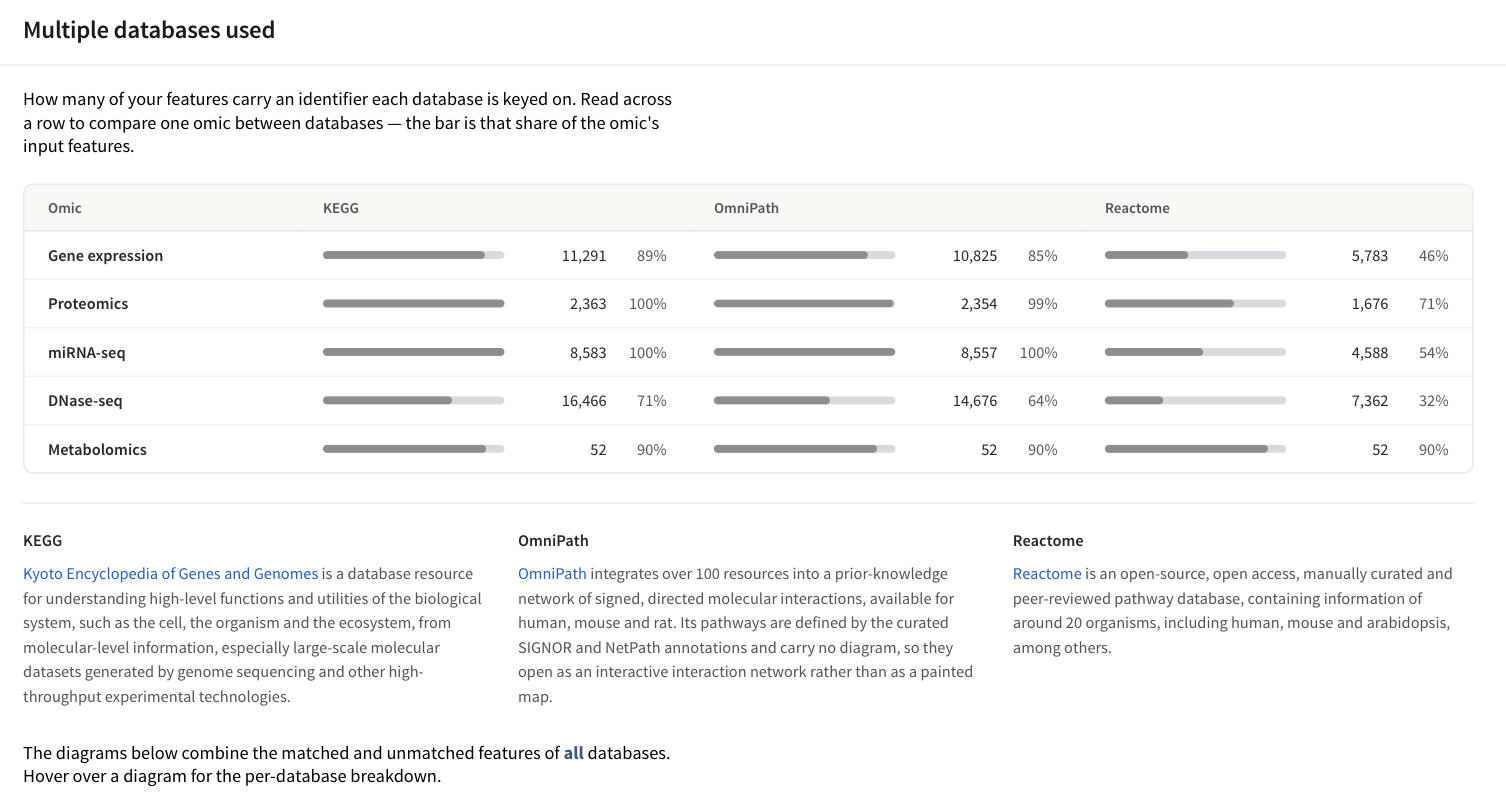
One row per omic, one bar and count per database, with each database described underneath.
These figures are not a ranking. The databases use different identifier types and differ in scope by design, and a feature counts as soon as its name resolves, even if it belongs to no pathway in that database. Pathway coverage is reported later, in the enrichment table.
To see exactly which of your identifiers resolved and to what, use Download
ID/Name mapping results under the translation summary. You get one zip per
job holding, for every omic, a _matched.txt — your input name, the name and
identifier it resolved to, which database it matched, your values and the
relevance flags — and a _unmatched.txt listing everything that did not
resolve. The same link is on Step 3 under Mapping and data statistics, but
that card starts collapsed: press Show mapping in the toolbar first.
When a file maps poorly
Work through these in order.
- Check the organism. A human file run as mouse resolves almost nothing. This is the single most common cause.
- Check the first column for version suffixes.
ENSMUSG00000102693.2is notENSMUSG00000102693. Strip the suffix and run again. - Check that the identifier type is one the organism has. Consult the
table above, then confirm against your own
_unmatched.txt. For an organism built by the default script, gene symbols and KEGG gene ids are the safest choices; Ensembl and RefSeq accessions will not resolve. - Look at which database is low, not just the total. A file that maps well to KEGG and badly to OmniPath is normal — OmniPath is keyed on UniProt accessions and covers a curated subset of signalling.
- Expect a metabolite file to look worse than a gene file. Names are matched against KEGG compound names; a house naming scheme, a lipid species name or an unannotated feature id has nothing to match. Uploading KEGG compound ids or ChEBI ids avoids the problem entirely.
If every gene-based omic maps to zero and no compound was selected either, PaintOmics stops when you continue from Step 2 and says so — naming the omic, how many identifiers it holds and a few of the ones that failed — rather than carrying an empty analysis forward.
If instead you see a message that the organism cannot translate identifiers for a database, that is a server configuration fault, not a problem with your file: the database's pathways are installed but the identifier table it is configured to use was never built. Report it to the administrators and run the job against another database in the meantime.
The AI input converter can repair a file whose format the analysis cannot read — the wrong delimiter, a spreadsheet with a header block, values in the wrong columns. It does not translate identifiers; that is what the mapping described on this page does.
See also
- Your first analysis — where Step 1 and Step 2 sit in a whole job.
- Preparing your data — file layouts for each kind of omic.
- The KEGG pathways database, Reactome, MapMan and OmniPath — what each source contributes.
- Frequently asked questions — limits, errors and job recovery.